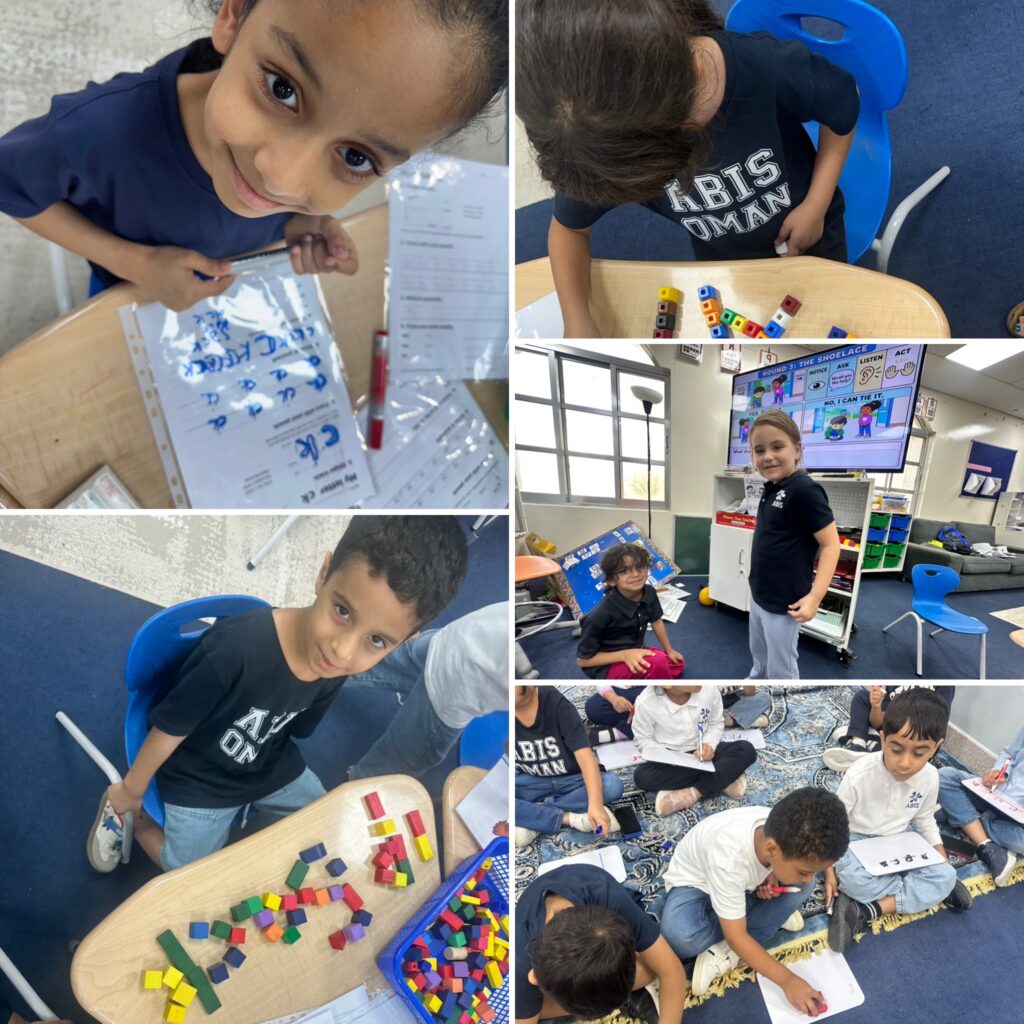
We had an exciting week of learning and growing together! A big highlight was officially launching our Guided Group Reading (GGR) groups—thank you for reviewing the information sent home earlier this week.
Here is a recap of what we covered in class, along with targeted suggestions for home practice.
 Phonics & Reading Focus: Tricky Short Vowels (/a/, /e/, /i/)
 Phonics & Reading Focus: Tricky Short Vowels (/a/, /e/, /i/)
What We Learned: We expanded our phonics toolkit with our new sounds and spent extra time applying them during Guided Group Reading.
Focus Area: Many Grade 1 learners naturally mix up short vowel sounds because they sound so similar! We are paying special attention to distinguishing between /a/ (like apple), /e/ (like egg), and /i/ (like insect).
Home Practice: Vowel Confusion Boosters
 Home Practice: Vowel Confusion Boosters
- Vowel Mouth-Shape Challenge: Have your child look in a mirror while saying the short vowel sounds:
- /a/ = Big open mouth (“ah” like taking a bite of an apple)
- /e/ = Wide smile/chin drops slightly (“eh”)
- /i/ = Wrinkle nose/slight smile (“ih”)
- The “Minimal Pair” Swap: Say two words that differ by only one vowel and ask your child to identify which sound changed (or spell them out):
- pan vs. pen vs. pin
- hat vs. hen vs. hit
- bag vs. beg vs. big
- rat vs. rest vs. rip
- Target Word Bank (Focusing on /a/, /e/, and /i/):
- Short /a/: cat, cap, hat, rat, ran, trap, pack, ants
- Short /e/: pen, pet, ten, net, hen, peck, step, nest, rest, rent
- Short /i/: kit, hit, rip, sick, trip, spin, is, in, it
Mathematics
 Mathematics
What We Learned: We continued stretching our math muscles up to number 30! Students practiced ordering numbers, identifying missing numbers in sequences, and matching quantities to written numerals through hands-on games.
Home Practice Suggestions:
- “What’s Missing?” (1–30): Write a line of sequential numbers up to 30 on paper with a few blanks (e.g., 14, 15, __, 17, 18, __). Have your child fill in the missing numbers.
- Mystery Quantity Estimation: Fill a cup with up to 30 small items (buttons, Lego bricks, or pasta). Have your child guess the total, then count them out 1-by-1 together to check.
- Count On Challenge: Give your child a starting point other than 1 (e.g., “Start at 16 and count up to 30!”).
Unit of Inquiry (UOI): All About Us – Relationships
 Unit of Inquiry (UOI): All About Us – Relationships
What We Learned: We explored how to build and maintain positive relationships across four core lessons:
- Friends Can Be Same & Different: Finding shared interests using Venn diagrams and practicing respectful invitations.
- What a Friend Does: Role-playing sharing, taking turns, and helping.
- Caring Starts with Noticing: Practicing our Notice ➔ Ask ➔ Listen ➔ Act routine and checking in on friends.
- Learning About One Another: Sharing personal items and asking Who, What, Where, Why, and How questions.
Home Practice Suggestions:
- Zones Check-In: At dinner, ask your child: “Which Zone were you in today? What helped you stay in or get back to the Green Zone?”
- Family Reporter: Encourage your child to ask a family member a “Why” or “How” question to learn something brand new about them!
IMPORTANT REMINDERS FOR NEXT WEEK
 IMPORTANT REMINDERS FOR NEXT WEEK
- Swimming (Mondays, 11:40–12:20): Students should arrive wearing regular school clothes. Please pack their swimsuit and full swim kit (towel, swim cap, goggles, flip-flops, and wet bag) in a separate, clearly labeled bag.
- Library (Tuesdays, 9:20–10:00): Please send a large, sturdy bag so your child can bring their library books home safely.
- Classroom Supplies: Please ensure your child has a labeled reusable water bottle and a set of working headphones (standard jack plug) in their backpack.
- Snacks & Lunch: Kindly pack healthy snacks and lunches in separate labeled bags, and remind your child to save their lunch for lunchtime. Note: Hot chips, chocolate, and candy are not permitted at school.
 Swimming (Mondays, 11:40–12:20): Students should arrive wearing regular school clothes. Please pack their swimsuit and full swim kit (towel, swim cap, goggles, flip-flops, and wet bag) in a separate, clearly labeled bag.
 Library (Tuesdays, 9:20–10:00): Please send a large, sturdy bag so your child can bring their library books home safely.
 Classroom Supplies: Please ensure your child has a labeled reusable water bottle and a set of working headphones (standard jack plug) in their backpack.
 Snacks & Lunch: